Tuesday, March 2, 2010

36 Arguments for the Existence of God By Rebecca Goldstein

The title of this book is misleading for a couple reasons. First, it is not a list of 36 arguments for the existence of god (although this information is in the appendix). Second, the title makes it sound like the author is making a case for god’s existence. Even if you take the novel format into account, this is not the case (The appendix that includes arguments for god’s existence only includes the arguments so they can be refuted). When I initially discussed this with a friend, I was chastised for not calling the book 36 Arguments for the Existence of God: A Work of Fiction (I kind of think it is a pain to include this subtitle in conversation), but it does help one know what to expect.

The book takes place during a couple weeks of Cass Seltzer’s career; he is a university professor of the psychology of religion and an author who has recently written a book about atheism. The book is not a list of 36 arguments for the existence of god, but he did include an appendix in his book (I believe that Goldstein’s appendix is meant to be Seltzer’s appendix). Even though the book spans a short amount of time, approximately half of the chapters are flashbacks, so the reader really gets to know Cass from the time he was in his 20’s. Several periods of Cass’s life are explained, his relationship with his eccentric mentor, his background as an Orthodox Jew, a failed marriage and a happy new relationship.

Although this is a book about one man’s explorations in religion and life, we can easily put Cass Seltzer’s atheism in perspective. Can’t we be good without the expectation of an eternal reward? Can’t we love our fellow humans without feeling that we are obligated by our religion? In my opinion, the book is less about the faiths that people embrace and more about the ways that they share their faiths and lives with others.

Tuesday, February 16, 2010

The Elegance of the Hedgehog By Muriel Barbery

This is a beautiful book written from the perspective of two intelligent yet introverted females; Renee, the concierge of an upscale Parisian apartment building, and Paloma, a young girl who lives with her family in the building. Each chapter takes the form of a themed journal entry. Renee hides her intelligence from the wealthy tenants of the building that she serves. Paloma tells us at the beginning of the book that she plans to commit suicide on her thirteenth birthday.

The arrival of a wealthy Japanese gentleman in the building disrupts the lives of both Renee and Paloma. Monsieur Ozu befriends each and helps them to begin to reevaluate the way that they see the world. The author’s recurring topics include philosophy, art, culture and class.

I worry that I have lost more than I should have in reading The Elegance of the Hedgehog in English rather than French (not that I could have read it in its original French). Near the end of the novel, one of the heroine’s makes a comment about having called someone vous (you, formal) rather than tu (you, informal) for many years. Until this moment in the novel, I hadn’t realized that she was calling her friend vous. I used to speak some French in High School – this may be the motivation that I need to learn again.

It amazes me that even though there are so many books that keep telling us that our lives are only as good as the people that we share them with, there are still many people who haven’t gotten the message. I’m not familiar with all of the philosophers and artists that are mentioned in the book, but I think that Barbery is trying to show us that understanding these scholars can only take you so far. Knowing and loving fellow humans is really the only way to appreciate all that art and nature have to offer.

Monday, February 1, 2010

Push, Pushing, Pushed

The heroine of Push by Sapphire (PS3569.A63 P87 1997), Precious Jones, is perhaps one of the most tragic characters in contemporary literature (at least, I can think of very few characters that rival her misfortunes). Often times, when I am reading a book, I think back to earlier portions of the story to find the protagonist’s mistake – the thing that they could have changed that would have prevented later misfortunes. In the case of Precious, I don’t think that this mistake exists; she was just a normal, good child who was overlooked and mistreated.

I assume that many folks already know the subject of the novel, due to its popularity and the movie based on the book that was recently released. For those of you who are not in the know, Precious Jones is an overweight, illiterate teen girl who at the beginning of the book is pregnant with her second child. She is abused by her mother and has been raped by her father repeatedly for several years. The story is about her attempts to receive a quality education and the dedicated instructor who encourages her. The determination and endurance that Precious exhibits is inspiring and a little bit heartbreaking.

Though this topic may seem grave and terrifying, the reader also sees the side of Precious’s life that is typical of any teen girl. She is cautious and concerned with her hair and clothes. She feels self-conscious about her body. Despite the years of rape, she still wants to meet a boy who loves her and finds her attractive. Even though my life and circumstances are very different from those of Precious, it is easy to relate to her.

In a fairly short novel, Sapphire manages to create a vivid picture of her heroine’s life, personality and aspirations. Perhaps one of the more impressive feats that Sapphire has accomplished is that her dialog and narration sound authentic, but are still easy to read. In this way, Sapphire brings us not only into Precious’s Harlem community, but her life.

Sunday, January 31, 2010

On Beauty (& many other things)


Without knowing much about the setting of On Beauty (PR6069.M59 O5 2005) by Zadie Smith, I began reading it around the same time that I read Happens Every Day by Isabel Gillies. The settings are very similar - both take place in small town liberal arts colleges; much of the main action of both books has to do with the infidelity of the husband/father. Beyond this, the books are not especially similar, but I may be doomed to think of the two as a pair based on the coincidence that I just described. The main difference between the two books was that I thought On Beauty was interesting, clever and enjoyable.

Even though Smith does talk a great deal about beauty in this novel, it could just as easily be called, On Race, On Class or On Marriage. Or any number of other titles. The Belsey family is made up of the parents and three children. Howard is the father, a professor of art history who originally comes from England. The mother, Kiki is a black woman from Atlanta who works at a local hospital. Jerome is the oldest son - the only Christian in a family of atheists. The daughter Zora is determined to be successful intellectually, but ends up being overbearing and commandeering more often than not. The youngest son, Levi, spends most of the novel trying to figure out what it means to be black in a small town with a very small black community.

I spend so much time explaining the unique positions of each of the family members, because I think the fact that their situations are so dramatically different is what makes the novel interesting. As mentioned before, the father's infidelity is crucial to the plot, as is the arrival of one of his professional rivals on the college campus, but, in my opinion, these events really just serve to illustrate the way that honesty, love and loyalty work in this culturally, emotionally, spiritually diverse family.

I'm very interested in novelists who don't seem to be concerned with whether or not their main characters are likable. Even though I haven't heard or read anything that describes Smith's own feelings on this subject, if I had to guess, I would say that she is more interested in making her characters realistic and believable. This doesn't necessarily mean that the characters aren't likable, just that they frequently do things that make the reader cringe. I consider it a mark of success on the part of the storyteller when I feel genuinely embarrassed for her characters.

Luckily, the book is fiction, so no matter what happens on the page, I can remind myself that these people didn't actually have to suffer these humiliations & heartbreaks. And if they survive, then us real folk probably can too.

Monday, January 25, 2010

Wordle


Wordle http://www.wordle.net/ is a Java program that will automatically transform any words of your choice into an artistic design called a Word Cloud. You can type in your own words or paste in a favorite quote from another document. The more often the word appears in your original text, the larger it will appear in the final Word Cloud. In this example, TEACHING and LEARNING were the most frequently used words.

Once you've created a Word Cloud you like, you can share it in the Wordle Gallery with other Wordle users. Perhaps more excitingly, you can also make a screen shot of your creation, edit it with Microsoft Paint or a similar program, and print it out. The possibilities--especially if you have a color printer--are pretty endless: invitations, t-shirt designs, PowerPoints, or simply a really memorable cover page for your next research paper. LH

Thursday, January 21, 2010

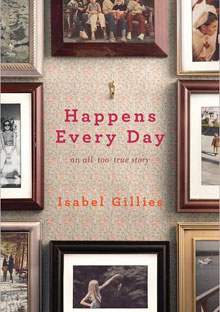
Review: Happens Every Day by Isabel Gillies

I was really excited to read the book Happens Every Day by Isabel Gillies. And not just because of an attractive cover or prominent display. I saw a recommendation on NPR - other NPR recommendations have been very enjoyable. I have lived in Ohio my entire life and this memoir is set in Oberlin, Ohio; I try to seek out literature from or about Ohio. It is also a non-fiction book by a female author. I sort of knew what the book was about, and was expecting an uplifting story about a strong woman.

Here’s the gist of the book: Isabel Gillies and her husband have a very dramatic relationship. They have two kids. Gillies moves from New England to Ohio with her husband who is a poetry professor. After a while, he meets and falls in love with one of the other professors at Oberlin. They separate. Don’t worry, I haven’t just given away the entire book, this is all mentioned at the beginning.

It sounds like I’m leaving out a lot, but I’m really not. When I got to page 17 of this 250+ page book, I set the book down and said to myself “How on earth will she manage to stretch this into a book length memoir?” The author must have also been wondering how she could fill up the remainder of her book. She seems to have settled on descriptions of designer apparel and home décor items, but she also includes repetitive memories of her privileged upbringing and expressions of amazement at the fact that Ohio is actually a nice place to live.

I don’t know whether I could briefly sum up the aspects of this book that bothered me. The voice of the novel just really began to irritate me. She struck me as being a frantic, needy, hypersensitive woman who defined herself solely based on appearances and her husband’s status. But it may just be that I don’t relate well to woman and I’m not really the right audience for the book. Maybe a different kind of person would find this more to their liking.

For a more enjoyable book about a philandering professor at a small Liberal Arts college, try Zadie Smith’s On Beauty. It isn’t non-fiction, but I found it much more interesting than Happens Every Day.

Monday, January 11, 2010

Perfect Pictures with Fotoflexor.com

I used to bemoan the fact that I do not have fancy image editing software on my personal computer, even though I could never justify such a thing. I’ve always made do with the basic image software on my computer when an editing need arose. Until I actually started using Fotoflexor.com (for free!), I didn’t realize how much I was missing.

To give you an idea of some of the things that Fotoflexor can be used for, I’m including a few pictures, an original and two that have been altered. As you can see, drastic changes have been made without sacrificing image quality. Usually, inexpesive image editors leave pictures looking grainy (in my opinion), but this is not the case here.

An example of something more practical that was achieved using Fotoflexor – the map featured on our Library Catalog page. I cut out and outlined the circle shape on an Ohio map, added star stickers to the map to identify Southwestern locations and converted the map to .png so the white areas would be transparent.

Some of the tasks that I frequently use Fotoflexor to accomplish:
Resizing images
Converting images from .jpg to .png (opaque to transparent)
Creating nice looking collages (this is easy to do in Paint as well, but the results are better with Fotoflexor)
Cutting out shapes and backgrounds


Although I use these features less frequently, Fotoflexor also allows you to:
Change shading/coloring of pictures
Add stickers, drawing and shapes
Retouch and Distort
And do many other useful things.

I’m sure I’ve really only begun to discover the possible uses for this free online system; there are so many potential uses that I’ve never had reason to investigate. But I imagine that there are many neat ways that altered images could be used in presentations and projects – rather than just copying an image directly from a search engine.